

COURSE 012
Legal, Regulatory, and Clinical Considerations in Testosterone and Androgen/IPED Care
COMPLIANCE
Learn how legal, regulatory, and documentation risks shape testosterone and androgen/IPED care, why harm reduction must be separated from reckless prescribing, and how defensible clinical standards protect both patients and clinicians.
PROGRAM Testosteronology® Professional Education Program, Testosteronology Society®
ESTIMATED TIME TO COMPLETE 45 Minutes Reading + 40 Minute Video
TARGET AUDIENCE Clinicians treating patients with testosterone deficiency, androgen-related conditions, and broader hormonal health challenges.
COURSE FORMAT Evidence-informed clinical education module including text, video, and diagrams
FACULTY DISCLOSURE Authors and reviewers include Thomas O’Connor, M.D., and Omar Hajmousa, PharmD. This educational material is designed as an independent clinical training course. Formal CME accreditation cannot currently be claimed.
CONTENT DISCLOSURE This educational material was developed with editorial assistance from AI technology and then reviewed, revised, and verified by the Testosteronology Society® faculty to ensure accuracy, clinical appropriateness, and educational value.
COURSE PREREQUISITES Courses are structured to be taken in sequence so clinicians can build a coherent clinical framework. Individual courses may be revisited anytime for refresher learning or when a patient presentation relates to a topic addressed in the curriculum.
IMPORTANT NOTE The course material is provided for general educational and informational purposes only. It is not intended to serve as medical advice, diagnosis, or treatment recommendations for any specific individual.
COURSE 012 OVERVIEW
Legal and regulatory risk in testosterone, androgen, and IPED care is not created by testosterone alone. It is created when indication, dose, target level, documentation, monitoring, patient risk, physician intent, and follow-up do not fit together as defensible medical care. The same testosterone molecule can sit inside medically appropriate replacement therapy, legally vulnerable enhancement prescribing, supervised harm-reduction care for a patient already exposed to anabolic steroids, or reckless hormone commerce. The difference is not simply the drug. The difference is the clinical reasoning chain that supports the decision. This course trains clinicians to understand that chain before a chart, patient complaint, adverse event, board inquiry, malpractice review, or controlled-substance audit forces the issue.
This course begins with Dr. O’Connor’s prolonged regulatory investigation because that experience frames the legal topic as a real physician-protection lesson rather than a dry regulatory review. It then moves into harm reduction, anabolic steroid withdrawal, suicide risk, standard-of-care expectations, Schedule III status, the 1990 steroid era, FDA labeling changes, TRAVERSE, blood pressure concerns, the line between replacement and steroid prescribing, documentation standards, telemedicine vulnerability, global access differences, and the modern gray market around SARMs, peptides, GLP drugs, research chemicals, and underground IPEDs. The goal is not to make clinicians fearful of testosterone care. The goal is to make clinicians serious enough that their care can be reviewed later and still look like high-quality medicine.
COURSE 012 LEARNING OBJECTIVES
After completing this course, clinicians should be able to:
① Explain why legal and regulatory risk in testosterone and androgen/IPED care depends on indication, dose, target level, documentation, monitoring, patient risk, physician intent, and follow-up.
② Describe how Dr. O’Connor’s regulatory investigation illustrates the importance of defensible records, harm-reduction reasoning, and professional standards in complex androgen care.
③ Distinguish medically necessary testosterone replacement from anabolic steroid prescribing, enhancement-driven care, anti-aging marketing, and supervised harm-reduction management.
④ Recognize why abrupt discontinuation, anabolic steroid withdrawal, psychiatric instability, and suicide risk must be considered when caring for patients already exposed to supraphysiologic androgen use.
⑤ Explain the clinical importance of testosterone’s Schedule III status, FDA labeling evolution, DEA authority, state medical board scrutiny, and telemedicine prescribing rules.
⑥ Apply a defensible documentation framework that includes symptoms, H&P, repeat laboratory confirmation, fertility counseling, physical examination considerations, informed consent, monitoring, and adverse-event surveillance.
⑦ Identify how global access differences, gray-market sourcing, SARMs, peptides, research chemicals, and IPED exposure complicate patient safety and professional liability.
⑧ Explain why Testosteronology® should be practiced as rigorous androgen medicine rather than anti-aging sales, bodybuilding facilitation, or unstructured hormone enthusiasm.
COURSE 012 TOPICS
The following topics will be covered in the course text, video, diagrams or downloadable documents:
① Testosterone And Androgen/IPED Care As A Legal And Clinical Reality
② Schedule III Status, FDA Labeling, DEA Oversight, And Outside Review
③ The Historical Steroid-Abuse Lens And Modern Clinical Tension
④ FDA Labeling Changes Do Not Remove Clinical Liability
⑤ Replacement Therapy Versus Steroid Prescribing
⑥ Documentation Standards And Defensible Clinical Reasoning
⑦ Dr. O’Connor’s Regulatory Investigation As A Professional Warning
⑧ Harm Reduction, Withdrawal Risk, And Already-Exposed Patients
⑨ Telemedicine, TRT Clinics, Compounding, And Practice Vulnerability
⑩ Global Access, Gray-Market IPEDs, Research Chemicals, And Professional Boundaries
⑪ Testosteronology® As Rigorous, Documented, Patient-Safety-First Androgen Medicine
“Legal protection in testosterone and androgen care begins with excellent medicine: clear indication, honest documentation, careful monitoring, and the discipline to separate replacement therapy from enhancement.”


Thomas O'Connor, M.D.
Founder / CEO
THIS ENDS THE NON-MEMBER PREVIEW OF COURSE 012
Become an Associate Testosteronologist® and unlock the complete 14-Course Educational Program from the Testosteronology Society® to advance your clinical knowledge in testosterone and androgen medicine.

Testosteronology® Professional Education Program + One Year Society Membership
◉ Access To The 14 Course Testosteronology® Professional Education Program
◉ Access To The Official Society TRT Guidelines
◉ Access To The Topic Presentations Library
◉ Access To Grand Rounds Recording Library
◉ Monthly Live Q&A Training Group Session
◉ Ongoing Clinical Education Updates
◉ Weekly Testosteronology Society® Insights Newsletter
◉ Professional Testosteronology Society® Member Designation
◉ Access To The Testosteronology Society® Website
012 Legal, Regulatory, and Clinical Considerations in Testosterone and Androgen/IPED Care
40 MINUTE COURSE TRAINING VIDEO
With Thomas O'Connor, M.D. Founder / CEO Testosteronology Society®
Video Lesson Takeaways
◉ The fastest way to get burned is not “testosterone exists,” it is sloppy classification and sloppy records while prescribing a controlled substance.
◉ Treat every initiation as if a regulator will read it later, because sometimes they do, and the story has to make sense without you in the room.
◉ The vulnerable moment is the gray zone, when dosing looks like enhancement but the chart pretends it is replacement, because that mismatch is easy to attack.
◉ If your diagnosis is not defensible on repeat labs and coherent clinical reasoning, the rest of your plan is just window dressing.
◉ Baseline risk assessment is not a formality, because blood pressure, hematocrit tendencies, and comorbid disease decide whether you are practicing safely.
◉ Informed consent is not a signature hunt, it is the paper trail that shows the patient understood tradeoffs, monitoring, and what the therapy can and cannot do.
◉ Monitoring failures are a liability amplifier, because harm often accumulates quietly while patients report feeling great.
◉ Documentation detail matters in surprising ways, because small omissions can become the centerpiece of a bigger accusation later.
◉ Online visibility and a public persona can attract scrutiny, and it changes the stakes when regulators are looking for “pattern” and “intent.”
◉ Telemedicine and compounding expand access, but they also expand complexity, and that complexity demands tighter standards, not looser ones.
◉ “Clinic culture” can drift toward easy prescribing, and that drift is exactly what triggers investigations, closures, and downstream patient chaos.
◉ Patients may show up after another clinic collapses, and your job is to stabilize physiology and expectations while keeping your own guardrails intact.
◉ Withdrawal, destabilization, and mental health fallout are not theoretical outcomes, so abrupt discontinuation and casual handoffs can have real consequences.
◉ You cannot practice safely without distinguishing replacement, enhancement, misuse, and harm-reduction intentions, because each requires different documentation and monitoring logic.
◉ When a subpoena arrives, the chart is your voice, so write like you will someday need your chart to speak calmly and clearly for you.
COURSE 012 TEXT
① Testosterone And Androgen/IPED Care As A Legal And Clinical Reality
Testosterone care is no longer a responsibility of a single specialist. It now appears in primary care, urology, endocrinology, men’s health, sports medicine, telemedicine, compounding, anti-aging marketing, and harm-reduction care for patients already exposed to AAS or IPEDs. The same clinic may see classic hypogonadism, prior anabolic steroid exposure, fertility concerns, women needing careful androgen assessment, adult gender-affirming care, or patients coming from aggressive optimization clinics.
That range makes testosterone legally and clinically sensitive because the same molecule can represent very different kinds of practice. Testosterone may be medically indicated as replacement therapy in one patient, enhancement prescribing in another, or part of harm-reduction management for someone already exposed to unsafe androgen use. The difference is the indication, dose, target range, patient context, monitoring, documentation, and clinician purpose.
The central standard is that testosterone care must look like medicine. A defensible chart should show why the patient was treated, what evidence supported the diagnosis, what risks were discussed, what monitoring was planned, and how abnormal findings would change management.[4,5]
② Schedule III Status, FDA Labeling, DEA Oversight, And Outside Review
In the United States, testosterone and many anabolic steroids remain Schedule III controlled substances.[1] That status matters because testosterone is not simply a wellness product. It requires a legitimate medical purpose, a defensible diagnosis, careful documentation, and ongoing monitoring.
FDA labeling and controlled-substance scheduling are related but separate issues. FDA labeling addresses approved indications, safety warnings, and product-specific prescribing language.[2] Controlled-substance status involves DEA/CSA oversight and does not disappear simply because FDA labeling changes.[1] A favorable labeling update may change the clinical conversation, but it does not remove the need for medical necessity, risk review, and documentation.
The practical lesson is straightforward: testosterone care has to withstand outside review. If another clinician, regulator, attorney, or board reviewer reads the chart later, the record should make clear why treatment was medically reasonable, what risks were considered, how the patient was monitored, and why the care was replacement or harm reduction rather than enhancement prescribing.
③ The Historical Steroid-Abuse Lens And Modern Clinical Tension
The legal framework around anabolic steroids was shaped heavily by athletic abuse, cheating, youth exposure, and public concern about sports culture. That history still affects how testosterone is viewed, even when the patient in front of the clinician is not an athlete and is not seeking performance enhancement.
Modern clinical reality is broader. Clinicians now see aging men with hypogonadism, men with functional suppression, post-AAS hypogonadism, fertility disruption, women needing carefully considered androgen care, adult gender-affirming care, illicit IPED exposure, underground peptide and SARM use, and patients harmed by aggressive hormone clinics.[4,6] The law still carries a drug-abuse lens, while medicine increasingly needs a structured clinical-care lens.
The clinician does not need to fight that tension. The clinician needs to practice clearly inside it. Testosterone therapy should be documented as medical treatment when it is medical treatment. Enhancement requests should not be disguised as replacement therapy. Harm-reduction care should be labeled honestly when the patient is already exposed and the clinician is reducing risk rather than endorsing use.
④ FDA Labeling Changes Do Not Remove Clinical Liability
The FDA labeling changes after TRAVERSE show that testosterone regulation is evolving, but not disappearing. Following TRAVERSE, the FDA recommended removing boxed-warning language related to increased risk of adverse cardiovascular outcomes from testosterone products, while also requiring labeling updates about increased blood pressure based on ambulatory blood pressure monitoring studies. A more favorable cardiovascular labeling environment does not remove the need for medical necessity, controlled-substance awareness, informed consent, blood-pressure monitoring, and defensible documentation.[3,4]
TRAVERSE should not be used as a shortcut to justify casual prescribing, supraphysiologic targets, weak follow-up, or enhancement-based care.[3,4] The trial changed part of the cardiovascular conversation, but it did not change the clinician’s responsibility to practice testosterone care as serious medicine.[3]
The regulatory lesson is straightforward: even when one warning changes, the clinician remains responsible for proving that testosterone was prescribed as legitimate medical treatment rather than poorly documented hormone commerce. FDA labeling may evolve, but the chart still has to show diagnosis, indication, risk assessment, monitoring, and clinical reasoning.
⑤ Replacement Therapy Versus Steroid Prescribing
The central liability line is the difference between testosterone replacement therapy and steroid prescribing. Testosterone can be a replacement hormone or an anabolic steroid depending on indication, dose, target level, patient context, monitoring, documentation, and intent.
TRT is medically indicated androgen replacement intended to restore physiologic androgen status in a patient with a defensible diagnosis.[4,5] Enhancement prescribing seeks muscle, performance, cosmetic, sexual, energy, or wellness effects without accepted medical indication, especially when exposure is supraphysiologic.[6] Harm-reduction care is separate from both: it means caring for patients already using or exposed to AAS/IPEDs without endorsing or facilitating dangerous use.
Lab timing can make the distinction harder. A testosterone level drawn near an injection peak may look very different from a trough or nadir level.[4,5] The clinician should document formulation, dose, timing of last dose, lab timing, target range, and clinical interpretation. If the chart cannot explain the number, the number may be interpreted against the clinician later.
⑥ Documentation Standards And Defensible Clinical Reasoning
Documentation is clinical armor. Every testosterone patient should have a record that shows why care is medically reasonable. The core note should include symptoms and clinical presentation, appropriate testosterone testing, free testosterone and SHBG when clinically relevant, LH and FSH when classification matters, fertility considerations, focused physical examination considerations, prostate and testicular assessment when appropriate, CBC and hematocrit, blood pressure, sleep apnea risk, prior AAS/IPED exposure, psychiatric risk, informed consent, and a monitoring plan.[4,5]
The note does not need to be long. It needs to be specific. “Low T, start testosterone” does not show diagnostic reasoning, risk review, patient selection, or follow-up logic. A defensible note explains what is being treated, what evidence supports the diagnosis, what risks were reviewed, and what findings would change the plan.
Dr. O’Connor’s investigation illustrates this documentation lesson directly. He describes ultimately being cited for a documentation issue involving failure to document testicular size in seven patients, despite the broader investigation focusing on complex androgen and AAS-exposed care. The moral is not that every note needs to be excessive. The moral is that the chart must be able to defend the diagnosis and the clinical reasoning after the visit is over.
⑦ Dr. O’Connor’s Regulatory Investigation As A Professional Warning
Dr. O’Connor’s investigation shows how androgen care can be judged long after the visit is over. He describes being under investigation for nearly five years by Connecticut public health and controlled drug authorities after a patient suicide drew attention to his care of men using anabolic steroids. The point is not resentment toward regulators. The point is that the chart may have to explain the case to people who were not present and may not understand modern androgen medicine.
Many complex androgen patients are not routine TRT patients. They may already be exposed, suppressed, symptomatic, infertile, depressed, dependent on androgen use, or medically unstable. The physician may be trying to reduce harm, but outside reviewers may see controlled substances and risk before they see clinical nuance. That is why the record must show the difference between treating a harmed patient and facilitating misuse.
The professional warning is direct. Even medically reasonable care needs documentation that is meticulous, reproducible, and defensible. Testosterone care must look like internal medicine, not cash-clinic hormone sales, bodybuilding support, or casual enhancement prescribing.
⑧ Harm Reduction, Withdrawal Risk, And Already-Exposed Patients
Harm reduction is not permission to continue unsafe use. It is care for a patient who is already exposed to risk. Some patients using AAS or IPEDs are not ready to stop immediately. Others may be afraid to stop because past discontinuation caused severe fatigue, sexual dysfunction, depression, loss of identity, or hypogonadal symptoms.[6]
A reflexive “stop everything” response can be clinically incomplete when a patient is suppressed, dependent, depressed, or psychiatrically unstable. Dr. O’Connor specifically connects abrupt discontinuation and withdrawal-like crashes with severe outcomes in some patients. That does not mean unsafe use should be endorsed. It means the clinician must assess psychiatric risk, suicidality, mood instability, substance use, and safety concerns rather than treating androgen exposure as a simple yes-or-no problem.[6,7]
The boundary remains firm. Treating hypertension, dyslipidemia, erythrocytosis, psychiatric disease, renal injury, cardiovascular disease, or other consequences of AAS/IPED exposure is harm reduction.[6] Prescribing in a way that maintains or enables an unsafe enhancement cycle is facilitation. The chart should make that difference unmistakable.
⑨ Telemedicine, TRT Clinics, Compounding, And Practice Vulnerability
Telemedicine, TRT clinics, anti-aging clinics, wellness clinics, online hormone practices, and compounding models increase the importance of documentation because they can make testosterone care look commercial rather than medical. Access is valuable, but access does not lower the standard of care.
Testosterone should not be treated as a product. When care is built around fast access, high volume, patient demand, or optimization language, the chart becomes even more important. The clinician still needs a defensible diagnosis, risk assessment, monitoring plan, informed consent, and response to abnormal findings.[4,5]
High-volume hormone care creates risk when notes become templated, dosing becomes repetitive, follow-up is weak, and abnormal markers do not change the plan. A practice model that does not allow time for diagnosis, risk review, monitoring, and patient counseling is not compatible with high-integrity Testosteronology® care.
⑩ Global Access, Gray-Market IPEDs, Research Chemicals, And Professional Boundaries
Global access patterns complicate androgen care. Some regions control anabolic steroids tightly, while others have looser practical access through pharmacies, gyms, clinics, online vendors, or cross-border markets. Patients may obtain testosterone, AAS, SARMs, peptides, hCG, growth hormone secretagogues, thyroid drugs, insulin, GLP agents, clenbuterol, diuretics, or other compounds outside regulated medical care.[6]
The clinician’s role is not to supervise underground use. The clinician’s role is to understand what the patient is exposed to, assess medical risk, treat complications, counsel honestly, and maintain clear professional boundaries. A patient’s ability to obtain a compound does not make that compound medically appropriate or legally clean.
Professional boundaries matter most when patients ask the clinician to make unsafe use safer without changing the behavior. The clinician can evaluate risk, treat disease, counsel honestly, and monitor harm. The clinician should not become the manager of underground AAS, peptide, SARM, or research-chemical protocols.[6]
⑪ Testosteronology® As Rigorous, Documented, Patient-Safety-First Androgen Medicine
Testosteronology® is not anti-access, anti-regulation, or anti-harm-reduction. It is a disciplined approach to androgen care that requires medical indication, patient safety, clear boundaries, and defensible documentation. Access is appropriate when care is medically justified. Access becomes dangerous when it replaces diagnosis.[4,5]
The physician’s legal protection comes from the same behaviors that protect the patient: careful classification, repeatable evidence, informed consent, blood-pressure and hematologic monitoring, fertility discussion, psychiatric awareness, response to adverse trends, and documentation that another clinician can understand.[5] Testosterone care should never depend on enthusiasm, patient demand, or marketing language.
Treat testosterone and androgen/IPED care as serious medicine. Separate replacement from enhancement. Separate harm reduction from facilitation. Separate patient access from hormone commerce. The clinician who does that consistently is better positioned to help patients and withstand scrutiny.
COURSE 012 SUMMARY
Testosterone and androgen/IPED care carries clinical, legal, and regulatory responsibility for the clinician. Testosterone remains a controlled substance in the United States, and FDA labeling changes do not remove the need for defensible diagnosis, documentation, risk review, and monitoring.[1-3]
Clinicians must clearly distinguish testosterone replacement therapy from steroid prescribing, enhancement care, and harm-reduction management. TRAVERSE changed part of the cardiovascular discussion, but it did not make testosterone care casual.[3] Blood pressure, hematocrit, cardiometabolic risk, sleep apnea, fertility, psychiatric status, prior AAS/IPED exposure, and adverse trends remain central to safe care.[4,5]
Dr. O’Connor’s investigation serves as the professional warning behind this standard. Even clinically reasonable androgen care can look dangerous if the chart does not clearly show the diagnosis, patient context, risk assessment, informed consent, monitoring, and boundary between treatment, harm reduction, and facilitation. Testosteronology® should be practiced as serious medicine, not hormone commerce.
COURSE 012 EVALUATION
Legal, Regulatory, and Clinical Considerations in Testosterone and Androgen/IPED Care
This self-evaluation helps you confirm your understanding of the course material. There is no passing or failing score — it is a tool for reflection and review.
Course 012 Reviewed
You have completed the self-evaluation for Legal, Regulatory, and Clinical Considerations in Testosterone and Androgen/IPED Care. Review any flagged topics in the course content above before proceeding.
Question Summary
COURSE 012 REFERENCES
- Drug Enforcement Administration, Diversion Control Division. Controlled Substances by CSA Schedule. U.S. Department of Justice; 2026.
- U.S. Food and Drug Administration. FDA Issues Class-Wide Labeling Changes For Testosterone Products. February 28, 2025.
- Lincoff AM, Bhasin S, Flevaris P, et al. Cardiovascular safety of testosterone-replacement therapy. N Engl J Med. 2023;389(2):107-117.
- Bhasin S, Brito JP, Cunningham GR, et al. Testosterone therapy in men with hypogonadism: an Endocrine Society clinical practice guideline. J Clin Endocrinol Metab. 2018;103(5):1715-1744.
- American Urological Association. Testosterone Deficiency Guideline. American Urological Association; 2018, validity confirmed 2024.
- Pope HG Jr, Wood RI, Rogol A, Nyberg F, Bowers L, Bhasin S. Adverse health consequences of performance-enhancing drugs: an Endocrine Society scientific statement. Endocr Rev. 2014;35(3):341-375.
- Kanayama G, Brower KJ, Wood RI, Hudson JI, Pope HG Jr. Anabolic-androgenic steroid dependence: an emerging disorder. Addiction. 2009;104(12):1966-1978.
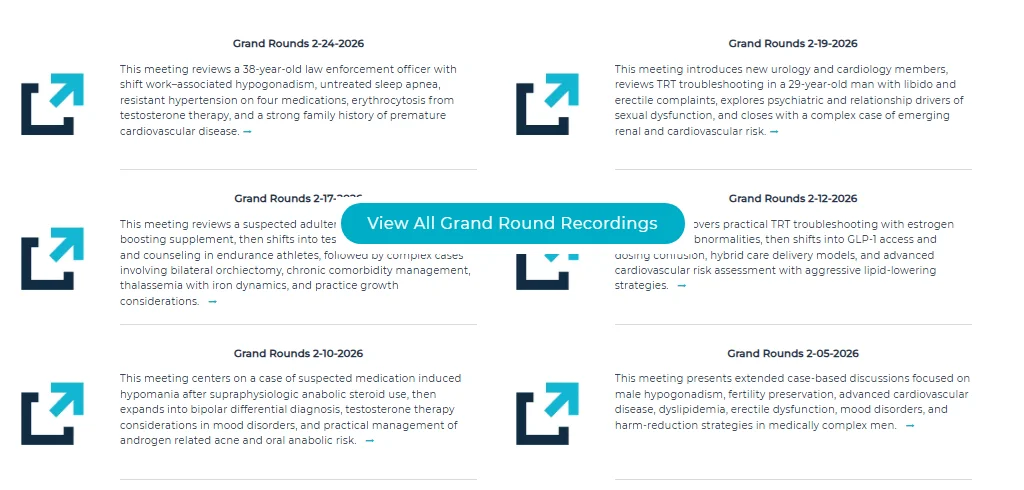
Recommended Grand Rounds Case Reviews

Testosteronology® Professional Education Program