

COURSE 008
Harm Reduction Strategies for Androgen and IPED Users: The A.R.M.® Three-Door Framework
SAFETY
Learn how to manage androgen and IPED-exposed patients using the A.R.M.® Three-Door Framework, and why staged recovery pathways, fertility-aware counseling, psychiatric support, and structured harm-reduction medicine are essential for moving patients away from chaotic exposure and toward safer endocrine care.
PROGRAM Testosteronology® Professional Education Program, Testosteronology Society®
ESTIMATED TIME TO COMPLETE 45 Minutes Reading + 73 Minute Video
TARGET AUDIENCE Clinicians treating patients with testosterone deficiency, androgen-related conditions, and broader hormonal health challenges.
COURSE FORMAT Evidence-informed clinical education module including text, video, and diagrams
FACULTY DISCLOSURE Authors and reviewers include Thomas O’Connor, M.D., and Omar Hajmousa, PharmD. This educational material is designed as an independent clinical training course. Formal CME accreditation cannot currently be claimed.
CONTENT DISCLOSURE This educational material was developed with editorial assistance from AI technology and then reviewed, revised, and verified by the Testosteronology Society® faculty to ensure accuracy, clinical appropriateness, and educational value.
COURSE PREREQUISITES Courses are structured to be taken in sequence so clinicians can build a coherent clinical framework. Individual courses may be revisited anytime for refresher learning or when a patient presentation relates to a topic addressed in the curriculum.
IMPORTANT NOTE The course material is provided for general educational and informational purposes only. It is not intended to serve as medical advice, diagnosis, or treatment recommendations for any specific individual.
COURSE 008 OVERVIEW
Clinicians are already caring for men with anabolic steroid exposure, androgen dependence, infertility, persistent hypogonadal symptoms, withdrawal syndromes, mood instability, erythrocytosis, dyslipidemia, sexual dysfunction, hepatic strain, and cardiovascular risk. The clinical failure when treating this population is that they are still often approached with rigid abstinence demands on one side or loosely permissive continuation on the other. A stronger model keeps the patient engaged, defines the endocrine and psychiatric realities clearly, and creates a structured off-ramp from chaotic exposure toward safer long-term care. [1,6,7]
The Anabolic Recovery Medicine® (A.R.M.®) Three-Door Framework provides that structure. Door 1 is cessation with monitoring. Door 2 is cessation with endocrine-supported recovery. Door 3 is formal physiologic testosterone therapy only for selected men after substantial abstinence, persistent symptomatic biochemical hypogonadism, and full evaluation. Not every patient is ready for the same intervention on day one. Forcing the wrong path at the wrong time increases relapse, concealment, and avoidable harm. [1,2]
COURSE 008 OBJECTIVES
After completing this course, clinicians should be able to:
① Apply the A.R.M.® Three-Door Framework to men with anabolic steroid, androgen, or broader IPED exposure.
② Distinguish candidates for cessation with monitoring, endocrine-supported recovery, and transition to formal testosterone therapy.
③ Perform a structured pre-management assessment including exposure history, symptom burden, psychiatric risk, fertility goals, and baseline laboratory evaluation.
④ Interpret the potential roles and limitations of hCG, clomiphene, enclomiphene, and selected lower-evidence adjuncts in A.R.M.®
⑤ Integrate fertility counseling, relapse prevention, psychiatric support, and long-term risk reduction into management of androgen and IPED users.
COURSE 008 TOPICS
The following topics will be covered in the course text, video, diagrams or downloadable documents:
① Why Harm Reduction Matters in Androgen and IPED Medicine
② Core Clinical Philosophy of the A.R.M.® Three-Door Framework
③ Pre-Management Assessment Before Choosing a Door
④ Door 1 - Stop All Steroids and Monitor Recovery
⑤ Door 2 - Stop Steroids and Support Recovery with Endocrine Therapy
⑥ Door 3 - Transition to Physiologic Testosterone Therapy
⑦ Fertility and Reproductive Counseling
⑧ Psychiatric and Behavioral Harm Reduction
⑨ What Makes This Harm Reduction Rather Than Permissive Care
⑩ Clinical Integration and Final Management Logic
“The mistake is forcing the patient into the door you are most comfortable with. The real clinical skill is recognizing which door the patient is actually ready for, and guiding them forward without losing them.”

Thomas O'Connor, M.D.
Founder / CEO
THIS ENDS THE NON-MEMBER PREVIEW OF COURSE 008
Become an Associate Testosteronologist® and unlock the complete 14-Course Educational Program from the Testosteronology Society® to advance your clinical knowledge in testosterone and androgen medicine.

Testosteronology® Professional Education Program + One Year Society Membership
◉ Access To The 14 Course Testosteronology® Professional Education Program
◉ Access To The Official Society TRT Guidelines
◉ Access To The Topic Presentations Library
◉ Access To Grand Rounds Recording Library
◉ Monthly Live Q&A Training Group Session
◉ Ongoing Clinical Education Updates
◉ Weekly Testosteronology Society® Insights Newsletter
◉ Professional Testosteronology Society® Member Designation
◉ Access To The Testosteronology Society® Website
008 Harm Reduction Strategies for Androgen and IPED Users: The A.R.M.® Three-Door Framework
73 MINUTE COURSE TRAINING VIDEO
With Thomas O'Connor, M.D. Founder / CEO Testosteronology Society®
Video Lesson Takeaways
◉ A.R.M.® gives clinicians a structured way to manage androgen and IPED users according to where the patient actually is physiologically and psychologically.
◉ The first decision is not which medication to use, but whether the patient belongs in Door 1, Door 2, or Door 3.
◉ Door 1 offers the cleanest path to biologic recovery, but it often fails when withdrawal symptoms and relapse risk are underestimated.
◉ Door 2 is the center of recovery medicine because many patients need medical support to come off steroids without destabilizing.
◉ hCG can support testicular function and fertility-oriented goals, but it should not be described as full restoration of endogenous recovery.
◉ Clomiphene remains a useful off-label option in selected patients who are trying to recover endogenous function after prolonged suppression.
◉ Enclomiphene is promising, but it should still be discussed carefully because the direct recovery evidence is limited.
◉ Aromatase inhibitors belong in a lower-confidence category and should not be treated as routine recovery therapy.
◉ Door 3 should be reserved for selected men with persistent symptomatic biochemical hypogonadism after meaningful abstinence and proper evaluation.
◉ Fertility goals have to be addressed early because they often determine which management path is medically appropriate.
◉ Psychiatric instability, body-image dependence, and withdrawal dysphoria are often major reasons recovery attempts fail.
◉ Good harm-reduction care keeps the patient engaged while moving him away from chaotic exposure and toward a safer endocrine state.
COURSE 008 TEXT
① Why Harm Reduction Matters in Androgen and IPED Medicine
Clinicians are already treating the downstream consequences of androgen and IPED exposure. Patients present with suppressed gonadotropins, endogenous testosterone failure, infertility, low libido, erectile dysfunction, mood disturbance, erythrocytosis, dyslipidemia, liver enzyme abnormalities, and cardiovascular risk. The clinician’s role is to build a path out of chaotic exposure toward safer endocrine management and long-term risk reduction [1,7]. IPED exposure often extends beyond anabolic steroids to include SARMs, peptides, pro-hormones, stimulants, thyroid agents, and other performance drugs used in complex stacking patterns, often alongside recreational substances that further complicate polypharmacy.
Harm reduction in this setting means keeping the patient engaged long enough to reduce black-market exposure, reduce unmonitored polypharmacy, reduce infectious and cardiovascular harms, preserve fertility where possible, and create a realistic path toward a safer endocrine state without endorsing IPED use. This approach is supported by contemporary literature emphasizing engagement-first strategies in androgen and IPED users rather than abstinence-only models that often lead to disengagement and concealment. [5,10]
Weak care in this population usually follows one of two patterns. The first is dismissing the patient and telling them to stop everything immediately and return only when fully abstinent. The second is passive accommodation, where the clinician inherits the exposure and mistakes supervision for structured management. Neither approach is strong medicine. The better approach recognizes that readiness, physiology, fertility priorities, and psychiatric stability all determine what should happen next.
② Core Clinical Philosophy of the A.R.M.® Three-Door Framework
The core philosophy of A.R.M.® should anchor the entire course: not every patient is ready for the same intervention on day one. Clinicians can choose between 3 doors. Door 1 is cessation with monitoring. Door 2 is cessation with endocrine-supported recovery. Door 3 is formal physiologic testosterone therapy only for selected men with persistent biochemical and symptomatic hypogonadism after meaningful abstinence and full evaluation. Door 1 is the cleanest physiologic pathway, but not every patient can tolerate it. Door 2 is the center of A.R.M.® because it provides a medically supervised bridge. Door 3 requires the most restraint because it is not “cruising under supervision.” It is a formal treatment of established hypogonadism after real recovery attempts.
That distinction is central to maintaining clinical integrity. Patients should not be labeled by a door. They move between doors based on physiology, behavior, and response. Good management is not choosing a door once. It is recognizing when the current door no longer fits.
③ Pre-Management Assessment Before Choosing a Door
Before selecting any door, exposure history is the highest-yield variable in this population. The exact compounds used, duration of exposure, stacking patterns, cycling versus continuous use, and use of adjunctive agents determine how suppressed the axis is likely to be. Anabolic steroid–induced hypogonadism is typically secondary due to central suppression of gonadotropins, but prolonged exposure may also contribute to primary testicular dysfunction. Some patients follow a “blast and cruise” pattern, alternating supraphysiologic cycles with lower-dose maintenance exposure rather than fully discontinuing androgens. A vague history leads directly to poor door selection. [1,7]
Symptom burden must be organized, not just listed. In practice, one domain usually dominates the case. Some patients are driven primarily by sexual dysfunction and low libido. Others are driven by depressive withdrawal, anxiety, or loss of identity tied to physique and performance. Others are focused on fertility. These are not interchangeable problems. In this setting, the dominant symptom cluster often matters more than the absolute testosterone value when choosing a door.
Risk assessment should be prioritized. Psychiatric instability and relapse risk often determine whether Door 1 will fail. Cardiometabolic risk, erythrocytosis, and blood pressure trends determine how aggressively exposure needs to be reduced. The clinician should be asking: what is most likely to harm this patient next if nothing changes?
Baseline laboratory evaluation should support decision-making rather than exist as routine ordering. Total testosterone, LH, and FSH help define suppression patterns, but they are not the only meaningful signals. CBC, lipids, renal markers, liver enzymes, and fertility testing where appropriate often carry equal or greater importance depending on the case. Endocrine Society guidance reinforces that testosterone should be interpreted in symptomatic context and with repeat confirmation, but in this population, the broader physiologic picture is often more informative than a single hormone value. [2]
If exposure, symptoms, and risk are not prioritized correctly, the wrong door will be chosen. When that happens, failure is usually blamed on the treatment rather than on the initial assessment. Prior withdrawal attempts and the patient’s ability or inability to remain off steroids provide important signals about the likelihood of successful recovery without medical support.
④ Door 1 - Stop All Steroids and Monitor Recovery
Door 1 is the cleanest physiologic recovery pathway and should always be presented first, but it should not be presented casually. The best candidates are those with shorter exposure histories, strong motivation to stop, fertility goals, and enough psychological stability to tolerate a period of endocrine and identity disruption. That last factor is often underestimated.
Recovery timelines are variable. Some men will show gonadotropin recovery within months and gradual testosterone improvement, while others with longer or heavier exposure histories may take significantly longer or fail to normalize fully. Recovery probability generally declines as cumulative exposure increases, with longer and heavier androgen use associated with slower or incomplete recovery. [1,9]
Monitoring in Door 1 should be structured and deliberate. This includes symptom tracking, morning testosterone trends, gonadotropin recovery when still interpretable, sexual function, mood stability, relapse pressure, and fertility markers when relevant. The goal is to guide a biologic and behavioral recovery process.
⑤ Door 2 - Stop Steroids and Support Recovery with Endocrine Therapy
Door 2 is the center of A.R.M.®. This door is for patients who want to discontinue exposure but are unlikely to tolerate unsupported recovery due to severe symptoms, prolonged suppression, fertility urgency, or prior failed attempts. It is not a standardized protocol. It is a targeted, individualized strategy. [1,3,4]
The internal hierarchy of interventions must be clear. hCG and SERMs belong in the primary discussion. Aromatase inhibitors belong in a lower-confidence category and should not be presented as routine recovery tools. Without this hierarchy, options are often treated as equivalent.
hCG may support intratesticular testosterone production and spermatogenesis in suppressed patients, particularly when fertility is a priority. However, it does not restore endogenous pituitary signaling while it is being administered. A common misuse pattern is presenting hCG as “restarting the system” when it is actually supporting downstream function. That distinction changes expectations and clinical decision-making. [1,3]
Clomiphene increases gonadotropins and testosterone and remains one of the most supported off-label approaches for endogenous stimulation in this setting. It is particularly relevant in patients pursuing fertility or attempting to recover endogenous production after prolonged suppression. [1]
A common failure pattern is initiating clomiphene without defining a target or duration, then continuing indefinitely without reassessment.
Enclomiphene is increasingly discussed and may offer theoretical advantages, but evidence specific to anabolic recovery remains limited. It should be discussed with appropriate caution rather than presented as a superior replacement.
Aromatase inhibitors represent the weakest evidence category. A common misuse pattern is adding an aromatase inhibitor early because the patient is concerned about estrogen rather than because there is a clear physiologic indication. This may complicate recovery without clear evidence of benefit [6]. Door 2 is supervised recovery with incomplete evidence and uneven biology.
Another common real-world pattern is protocol stacking, where human chorionic gonadotropin (hCG), a selective estrogen receptor modulator (SERM), and an aromatase inhibitor (AI) are started together without a clear rationale for each component. This approach creates noise, complicates interpretation, and increases the risk of adverse effects without improving outcomes.
Strong Door 2 management requires defining the goal of therapy, selecting interventions based on that goal, monitoring response closely, and being willing to adjust or stop therapy when it is not working. This is decision-based medicine, not protocol-based medicine.
⑥ Door 3 - Transition to Physiologic Testosterone Therapy
Door 3 requires the highest level of clinical discipline because it is the easiest door to misuse. It is not for recent users, not for patients who have not attempted recovery, and not for those actively pursuing fertility. Door 3 is for patients with prolonged exposure history, persistent symptoms, persistently low testosterone, and inadequate recovery after meaningful abstinence and evaluation [2,5]. Door 3 should be used cautiously because it is difficult to justify well.
A common misuse pattern is initiating testosterone therapy early because the patient feels poorly during withdrawal. In these cases, testosterone is not treating established hypogonadism. It is bypassing the recovery process. This may provide short-term relief while committing the patient to unnecessary long-term therapy. Another pattern is justifying ongoing supraphysiologic exposure as “managed TRT,” which blurs the distinction between treatment and continuation of misuse. This undermines both clinical integrity and patient understanding.
Appropriate use of Door 3 requires adherence to endocrine principles. Therapy should target physiologic ranges, and monitoring should include hematologic parameters, cardiovascular risk, and prostate considerations [2]. The key decision point is whether testosterone is the correct long-term solution for the patient’s physiology and goals.
⑦ Fertility and Reproductive Counseling
Fertility is one of the most important variables in this entire framework, and it must be addressed early. Exogenous testosterone suppresses spermatogenesis and can lead to azoospermia, and recovery of sperm production does not always parallel recovery of testosterone levels. A patient may feel hormonally improved while still having impaired fertility. [2,3]
The most important question is simple: does the patient want children in the near future? That answer should influence door selection more strongly than most laboratory values. Recovery timelines for spermatogenesis are variable and often longer than patients expect. Some men recover within months, while others take significantly longer, particularly after prolonged exposure. This variability should be explained so expectations are realistic.
Door 1 may be appropriate for patients who can tolerate recovery and prioritize fertility. Door 2 may be necessary when fertility is urgent but unsupported recovery is unlikely to succeed. Door 3 is generally incompatible with active fertility goals and should be avoided in that setting.
A common clinical mistake is addressing fertility only after failure to conceive. By that point, suppression may be prolonged and more difficult to reverse. Early discussion allows for better planning, including consideration of recovery strategies or referral to reproductive specialists when needed.
⑧ Psychiatric and Behavioral Harm Reduction
This is not purely an endocrine problem, and treating it as one leads to predictable failure. Withdrawal dysphoria, anxiety, depressive symptoms, and loss of identity tied to physique and performance are central drivers of relapse.
A common real-world pattern is a patient who stops exposure, experiences a rapid decline in mood and motivation, and begins to feel disconnected from their prior identity. At that point, relapse is not driven by testosterone alone. It is driven by the combination of endocrine change and psychological destabilization. Severe withdrawal states may include depressive crises and suicidality, making psychiatric monitoring and support a critical component of management. Recent data show that psychiatric factors often correlate more strongly with symptom severity during withdrawal than hormone levels alone. [8] This reinforces the need to assess and address psychological factors directly.
Nonjudgmental follow-up is essential. Behavioral support, whether through structured counseling or coordinated care, should be considered part of treatment rather than an optional addition. Psychiatric stability also influences door selection. Patients with significant instability may fail Door 1 despite good intentions. That does not justify immediate transition to Door 3, but it may justify consideration of Door 2 as a more stable pathway. Ignoring the behavioral dimension of this problem is one of the most consistent reasons clinicians fail in this population.
⑨ What Makes This Harm Reduction Rather Than Permissive Care
Harm reduction means structured care that reduces risk while keeping the patient engaged. It includes reducing black-market exposure, polypharmacy, overdosing, and long-term complications. Permissive care ignores risk and normalizes harmful behavior. A.R.M.® is not permissive. It is disciplined medicine applied to complex behavior.
⑩ Clinical Integration and Final Management Logic
This decision requires integration of multiple domains. Exposure history, symptom burden, fertility goals, psychiatric stability, relapse risk, and laboratory findings all contribute. If you skip the recovery logic and move too quickly to Door 3, you may not be treating established hypogonadism. You may be formalizing a premature failure of management. Testosterone therapy often improves symptoms, but symptom improvement alone does not confirm that it was the correct long-term intervention.
Clinical integration also requires reassessment. Patients move between doors. A patient who fails Door 1 may need Door 2. A patient who does not recover after a structured attempt at Door 2 may eventually qualify for Door 3. The clinician must recognize when the current approach is not working and adjust. Good care in this population is structured, adaptive, and grounded in physiology and behavior. These patients do not need reassurance or judgment. They need disciplined, structured medical care that acknowledges complexity without avoiding it.
COURSE 008 SUMMARY
Management of androgen and IPED users requires a shift away from rigid, binary thinking and toward staged, physiology-driven decision-making. A.R.M.® gives the clinician a framework for meeting the patient where he is without surrendering standards of endocrine, reproductive, psychiatric, and cardiometabolic care [1,2,8,10]. The clinician who uses this framework well is not simply reacting to drug exposure. The clinician is building a medically supervised path away from it.
COURSE 008 EVALUATION
Harm Reduction Strategies: The A.R.M.® Three-Door Framework
This self-evaluation helps you confirm your understanding of the course material. There is no passing or failing score — it is a tool for reflection and review.
Course 008 Reviewed
You have completed the self-evaluation for Harm Reduction Strategies: The A.R.M.® Three-Door Framework. Review any flagged topics in the course content above before proceeding.
Question Summary
COURSE 008 REFERENCES
- Anawalt BD. Diagnosis and Management of Anabolic Androgenic Steroid Use. J Clin Endocrinol Metab. 2019;104(7):2490-2500.
- Bhasin S, Brito JP, Cunningham GR, et al. Testosterone Therapy in Men With Hypogonadism: An Endocrine Society Clinical Practice Guideline. J Clin Endocrinol Metab. 2018;103(5):1715-1744.
- Wenker EP, Dupree JM, Langille GM, et al. The Use of HCG-Based Combination Therapy for Recovery of Spermatogenesis after Testosterone Use. J Sex Med. 2015;12(6):1334-1337. doi:10.1111/jsm.12890.
- Stocks BT, Oppenheimer AG, Campbell KJ, et al. Optimal restoration of spermatogenesis after testosterone therapy using human chorionic gonadotropin and follicle-stimulating hormone. Fertil Steril. 2025;123(4):607-615. doi:10.1016/j.fertnstert.2024.10.019
- Smit DL, Verdegaal T, Bond P, de Ronde W. Approach to the Young Male Patient Who Abuses Androgens: Harm Reduction as a Clinical Strategy. J Clin Endocrinol Metab. 2025;111(1):e292-e297. doi:10.1210/clinem/dgaf496.
- Smit DL, de Ronde W. Aromatase inhibitors as a potential harm reduction strategy for selected men at risk of turning to illicit testosterone. Perform Enhanc Health. 2025;13:100060. doi:10.1016/j.peh.2025.100060.
- Handelsman DJ. Androgen Misuse and Abuse. Endocr Rev. 2021;42(4):457-501.
- Grant B, et al. Clinical features of androgen abuse withdrawal in men during the first year of cessation: a community-dwelling study. J Clin Endocrinol Metab. 2026.
- Shankara-Narayana N, Yu C, Savkovic S, et al. Rate and Extent of Recovery from Reproductive and Cardiac Dysfunction Due to Androgen Abuse in Men. J Clin Endocrinol Metab. 2020;105(6):1827-1839.
- Bonnecaze AK, O'Connor T, Burns CA. Harm Reduction in Male Patients Actively Using Anabolic Androgenic Steroids (AAS) and Performance-Enhancing Drugs (PEDs): a Review. J Gen Intern Med. 2021;36(7):2055-2064. doi:10.1007/s11606-021-06751-3
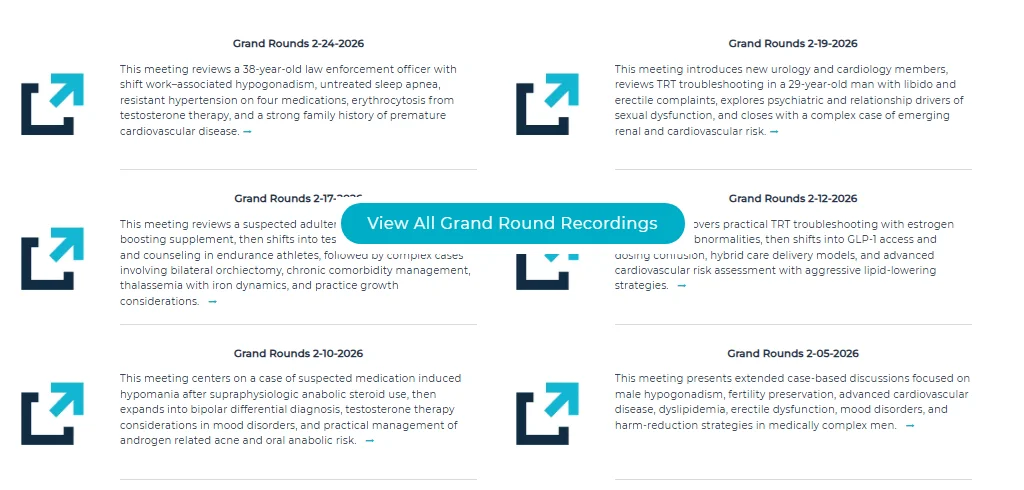
Recommended Grand Rounds Case Reviews
Testosteronology® Professional Education Program