

COURSE 002
Clinical Presentation of Testosterone Deficiency
DIAGNOSIS
Learn how testosterone deficiency presents across sexual, reproductive, physical, and systemic domains, and why careful clinicians diagnose a clinical syndrome rather than reacting to fatigue, low motivation, or a single laboratory value in isolation.
PROGRAM Testosteronology® Professional Education Program, Testosteronology Society®
ESTIMATED TIME TO COMPLETE 50 Minutes Reading + 48 Minute Video
TARGET AUDIENCE Clinicians treating patients with testosterone deficiency, androgen-related conditions, and broader hormonal health challenges.
COURSE FORMAT Evidence-informed clinical education module including text, video, and diagrams
FACULTY DISCLOSURE Authors and reviewers include Thomas O’Connor, M.D., and Omar Hajmousa, PharmD. This educational material is designed as an independent clinical training course. Formal CME accreditation cannot currently be claimed.
CONTENT DISCLOSURE This educational material was developed with editorial assistance from AI technology and then reviewed, revised, and verified by the Testosteronology Society® faculty to ensure accuracy, clinical appropriateness, and educational value.
COURSE PREREQUISITES Courses are structured to be taken in sequence so clinicians can build a coherent clinical framework. Individual courses may be revisited anytime for refresher learning or when a patient presentation relates to a topic addressed in the curriculum.
IMPORTANT NOTE The course material is provided for general educational and informational purposes only. It is not intended to serve as medical advice, diagnosis, or treatment recommendations for any specific individual.
COURSE 002 OVERVIEW
Clinical presentation is the front end of diagnosis. In practice, some men are labeled hypogonadal too quickly because they report nonspecific symptoms such as fatigue, low motivation, or poor concentration, even though these complaints are common across many other conditions. Others are underrecognized because they do not present seeking evaluation for testosterone deficiency. Instead, they enter through infertility, reduced morning erections, diminished libido, unexplained anemia, osteopenia, or physical findings that more clearly suggest androgen deficiency than their initial complaint. [1–4]
This course focuses on diagnostic discipline before treatment is considered. Emphasis is placed on the sexual symptom cluster, since it remains the most clinically useful adult feature when present together with laboratory confirmation. Many factors listed in the course can influence interpretation. Our goal is to recognize the syndrome accurately, classify it appropriately, and avoid both overdiagnosis and underrecognition. [1-6]
COURSE 002 LEARNING OBJECTIVES
After completing this course, clinicians should be able to:
① Define testosterone deficiency as a clinical syndrome that requires both compatible symptoms or signs and consistently low serum testosterone.
② Identify the most diagnostically useful adult symptom pattern, especially the sexual cluster of low libido, reduced morning erections, and erectile dysfunction.
③ Distinguish common but less specific symptoms, such as fatigue, low mood, poor concentration, and reduced performance, from features that more strongly support androgen deficiency.
④ Recognize physical, reproductive, and age-dependent manifestations of testosterone deficiency, including infertility, testicular findings, anemia, osteopenia, and delayed pubertal development.
⑤ Differentiate classical organic hypogonadism from functional hypogonadism and explain why similar outward presentations may reflect very different underlying biology.
⑥ Perform a focused history and physical examination that identifies symptom pattern, fertility goals, risk factors, medication contributors, sleep disruption, and clues to pituitary or testicular disease.
⑦ Avoid treating nonspecific symptoms or isolated laboratory values as proof of testosterone deficiency in the absence of a coherent clinical syndrome.
COURSE 002 TOPICS
The following topics will be covered in the course text, video, diagrams or downloadable documents:
① Definition And Clinical Framing
② Why Clinical Presentation Matters More Than Numbers Alone
③ The Sexual Symptom Cluster
④ Common But Less Specific Symptoms
⑤ Physical Signs And Downstream Manifestations
⑥ Fertility As A Presentation Pathway
⑦ Phenotype By Age Of Onset
⑧ Organic Versus Functional Hypogonadism
⑨ Focused Clinical History
⑩ Focused Physical Examination
⑪ What Not To Overcall
⑫ Society-Based Consensus And Practical Take-Home Points
“One of the biggest failures in modern androgen medicine is diagnostic overcalling. Fatigue is common. Low motivation is common. Poor concentration is common. Good clinicians know when those complaints belong to testosterone deficiency and when they belong to something else entirely.”


Thomas O'Connor, M.D.
Founder / CEO
THIS ENDS THE NON-MEMBER PREVIEW OF COURSE 002
Become an Associate Testosteronologist® and unlock the complete 14-Course Educational Program from the Testosteronology Society® to advance your clinical knowledge in testosterone and androgen medicine.

Testosteronology® Professional Education Program + One Year Society Membership
◉ Access To The 14 Course Testosteronology® Professional Education Program
◉ Access To The Official Society TRT Guidelines
◉ Access To The Topic Presentations Library
◉ Access To Grand Rounds Recording Library
◉ Monthly Live Q&A Training Group Session
◉ Ongoing Clinical Education Updates
◉ Weekly Testosteronology Society® Insights Newsletter
◉ Professional Testosteronology Society® Member Designation
◉ Access To The Testosteronology Society® Website
002 Clinical Presentation of Testosterone Deficiency
48 MINUTE COURSE TRAINING VIDEO
With Thomas O'Connor, M.D. Founder / CEO Testosteronology Society®
Video Lesson Takeaways
◉ Testosterone deficiency is a clinical syndrome, not a laboratory label.
◉ Diagnosis requires both compatible symptoms or signs and consistently low serum testosterone measured under appropriate conditions.
◉ In adult men, the most diagnostically useful presentation is sexual, especially low libido, loss of morning erections, and erectile dysfunction.
◉ Fatigue, low mood, poor concentration, and reduced physical performance are common, but they are far less specific.
◉ Some men present through infertility, anemia, bone loss, or testicular findings rather than through a direct sexual complaint.
◉ Similar presentations can arise from very different biology, including structural hypogonadism and potentially reversible functional suppression.
◉ Focused history matters because obesity, diabetes, sleep apnea, opioids, glucocorticoids, anabolic steroids, chronic illness, and circadian disruption can all affect presentation and interpretation.
◉ Clinicians must avoid treating numbers in isolation and instead learn to recognize phenotype, cause, and context before initiating androgen therapy.
COURSE 002 TEXT
① Definition And Clinical Framing
Testosterone deficiency, or male hypogonadism, is a clinical syndrome of androgen deficiency arising from dysfunction at the testicular level, the hypothalamic-pituitary level, or both. Symptoms come first. The laboratory result then confirms, refines, or challenges the impression. A man can have symptoms without testosterone deficiency, and he can have a low testosterone value without a clinically meaningful phenotype. Androgen therapy affects multiple physiologic systems, including cardiovascular, hematologic, reproductive, and metabolic health [1-4].
② Why Clinical Presentation Matters More Than Numbers Alone
Clinical interpretation of testosterone values depends on context. The same laboratory result can carry very different meanings based on many factors. A borderline value in a man with low libido, loss of morning erections, infertility, and testicular findings does not carry the same diagnostic weight as a similar value in a sleep-deprived, obese man with vague fatigue and no clear sexual or reproductive symptoms. In practice, many patients presenting for evaluation have already received a prior diagnosis and are seeking long-term management rather than initial identification of the syndrome.[1-4]
③ The Sexual Symptom Cluster
In adult men, the most diagnostically useful presentation remains sexual. Low libido, reduced morning erections, and erectile dysfunction carry more diagnostic weight than generalized low energy, poor concentration, or reduced drive, especially when they move together and fit the broader clinical picture. This is one reason multiple guidelines and reviews place sexual symptoms near the center of diagnostic reasoning and treatment benefit. [1-4]
That does not mean sexual symptoms are perfectly specific. Erectile dysfunction may be multifactorial. When low desire, reduced spontaneous or morning erections, and erectile dysfunction occur together, the probability of clinically meaningful androgen deficiency increases substantially. [1-4]
④ Common But Less Specific Symptoms
Regularly encountered but less specific symptoms include:
- Fatigue
- Low energy
- Reduced endurance
- Low mood
- Irritability
- Reduced motivation
- Poor concentration
- Reduced sense of well-being
These symptoms all deserve evaluation. They do not, by themselves, establish testosterone deficiency. These complaints are common across obesity, sleep restriction, depression, chronic pain, diabetes, medication effects, overwork, circadian disruption, and general physiologic strain. They may coexist with low testosterone, but they are too nonspecific to establish a defined endocrine syndrome on their own. That distinction is one of the most important forms of diagnostic restraint in androgen medicine.
⑤ Physical Signs And Downstream Manifestations
Physical and downstream clues that deserve particular attention include:
- Reduced testicular volume or soft testes
- Decreased facial or body hair in more severe deficiency
- Reduced lean muscle mass and strength
- Increased visceral or central adiposity
- Gynecomastia or breast tenderness
- Osteopenia or osteoporosis
- Fragility fractures or height loss
- Anemia without a better explanation
- Hot flashes or sweats in more severe deficiency
These findings add weight to the diagnosis and broaden the syndrome beyond subjective complaint. The Endocrine Society guideline explicitly includes many of these signs and manifestations among features that should raise suspicion for androgen deficiency. [1-3]
Some of these findings carry extra diagnostic value because they reflect downstream physiologic consequences rather than mood-based descriptions. Bone loss, fragility fractures, and unexplained anemia should not be treated as background details in a man with possible hypogonadism. They often point toward more chronic or more biologically meaningful androgen deficiency. [1-3]
⑥ Fertility As A Presentation Pathway
Some men do not present through sexual complaints at all. They present because they cannot conceive. This is one of the most important, and most commonly mishandled, entry points into testosterone deficiency. Infertility, oligospermia, azoospermia, abnormal semen parameters, and small testes may be the first clue that the hypothalamic-pituitary-testicular axis is not functioning normally. Reproductive health evaluation before testosterone treatment is explicitly emphasized in guideline-based care. [1-2]
Fertility changes the meaning of the presentation immediately. A clinician who reflexively hears “low testosterone” and thinks “testosterone replacement” has already skipped an essential diagnostic step. Even before management is discussed, reproductive presentation should sharpen attention to longstanding axis dysfunction, primary testicular disease, central causes, prior anabolic steroid exposure, and the difference between diagnostic clarification and treatment momentum.
⑦ Phenotype By Age Of Onset
Age of onset changes phenotype. Congenital conditions such as Kallmann syndrome and Klinefelter syndrome represent classical causes of longstanding hypogonadism that may present during puberty or early adulthood. Prepubertal or pubertal-onset hypogonadism may present with delayed puberty, under-virilization, sparse facial or body hair, small testes, reduced muscle development, and eunuchoidal body proportions. Adult-onset hypogonadism presents differently. Instead of absent development, the clinician sees loss or decline. [1-3]
That distinction matters because similar laboratory values can carry very different clinical meaning depending on developmental history. A man who never fully virilized or who had abnormal pubertal progression should immediately raise concern for longstanding central pathology. A middle-aged man with recent symptom onset and obesity-related comorbidity belongs to a different diagnostic frame. Developmental timing can help determine what kind of disease the clinician is actually looking at.
⑧ Organic Versus Functional Hypogonadism
One important distinction in modern androgen medicine is the difference between classical organic hypogonadism and functional hypogonadism. Organic hypogonadism reflects structural or irreversible pathology affecting the testes, hypothalamus, or pituitary. Functional hypogonadism reflects potentially reversible suppression of the axis related to obesity, systemic disease, medication exposure, undernutrition, sleep disruption, or other physiologic stressors. [1,5-6]
This distinction can change what further evaluation should look like, how strongly reversibility should be pursued, and how carefully the diagnosis should be framed before treatment is started. Organic hypogonadism should raise concern for entities such as pituitary or hypothalamic disease, congenital GnRH deficiency states, Klinefelter syndrome, prior orchitis, torsion, testicular injury, chemotherapy, radiation, or other gonadal pathology. Functional hypogonadism is commonly seen with obesity, type 2 diabetes, obstructive sleep apnea, chronic systemic illness, opioid or glucocorticoid exposure, severe stress, marked caloric deficit, or prior anabolic steroid exposure, which may lead to anabolic steroid–induced hypogonadism (ASIH).
⑨ Focused Clinical History
A strong history clarifies pattern, time course, severity, reversibility, and competing explanations. Loss of libido after years of normal function carries a different differential than incomplete pubertal development. New erectile dysfunction with preserved desire is not the same as parallel loss of desire and spontaneous erections. Fertility goals, fracture history, vasomotor symptoms, changes in muscle and fat distribution, and the timing of symptoms relative to weight gain, shift work, opioid use, steroid exposure, or major illness can all reshape the diagnostic impression before the laboratory workup is even reviewed. [1,5-6]
Risk-factor history is equally important. Obesity, diabetes, sleep apnea, chronic kidney or liver disease, HIV, pituitary symptoms such as headache or visual change, prior orchitis or torsion, chemotherapy, radiation, anabolic steroid exposure, glucocorticoids, and opioids all alter interpretation. Circadian disruption from shift work, night schedules, or irregular sleep patterns may also contribute to symptomatic testosterone suppression and should be specifically assessed. [1,5-6]
Useful history domains include:
- Sexual function pattern, including libido, morning erections, erectile change, and fertility goals
- Timing of symptoms in relation to illness, weight change, sleep disruption, medication exposure, or anabolic steroid use
- Pubertal development and developmental clues suggesting longstanding disease
- Pituitary or central symptoms such as headache, visual change, anosmia, or prior brain injury
- Chronic disease burden, including obesity, diabetes, sleep apnea, kidney disease, liver disease, and inflammatory illness
- Drug exposures such as opioids, glucocorticoids, chemotherapy, radiation, and exogenous androgens [1,5-6]
- A focused history is not a formality. In many patients, it is the highest-yield diagnostic tool in the visit
⑩ Focused Physical Examination
Physical examination can help uncover findings that shift the diagnostic story. Central adiposity and blood pressure may strengthen the case for functional suppression and cardiometabolic strain. Hair distribution and secondary sexual characteristics may raise concern for longstanding androgen deficiency. Gynecomastia, testicular size, and consistency may shift the clinician toward primary testicular or reproductive pathology. Skeletal clues such as height loss or kyphosis can point toward more chronic physiologic consequences. Examination should also remain attentive to testicular masses or asymmetry that could indicate underlying malignancy requiring urgent urologic evaluation. [1-3]
⑪ What Not To Overcall
One of the most valuable skills in this field is knowing what not to call testosterone deficiency. Low energy alone is not testosterone deficiency. Poor concentration alone is not testosterone deficiency. These complaints deserve attention, but they do not establish the syndrome by themselves. [1-4]
Likewise, an isolated testosterone value should not function as diagnostic closure when the phenotype is weak, the symptoms are nonspecific, or reversible suppressive factors are obvious. Overcalling usually happens when clinicians collapse multiple diagnostic steps into one. The antidote is disciplined weighting of symptoms, signs, cause, and context before treatment is even discussed.
Regularly overcalled scenarios include:
- Fatigue without persuasive sexual symptoms
- Obesity-related low testosterone with no attempt to interpret reversibility
- Poor sleep or shift work with weak endocrine symptoms
- Depression, chronic pain, or medication burden being relabeled as primary androgen deficiency
- Isolated laboratory values being treated as more meaningful than the clinical picture
⑫ Society-Based Consensus And Practical Take-Home Points
The practical lesson for clinicians is straightforward. Diagnose testosterone deficiency when the clinical presentation is convincing. Treat vague complaints as prompts for broader evaluation, not as automatic proof. Use fertility history, sexual symptoms, physical findings, age of onset, and cause-oriented reasoning to strengthen or weaken the impression before any prescription decision is made.
COURSE 002 SUMMARY
Clinical Presentation of Testosterone Deficiency teaches that diagnosis begins with clinical presentation, not with treatment interest and not with an isolated laboratory value. Adult men with low libido, reduced morning erections, and erectile dysfunction carry the most diagnostically useful symptom pattern, especially when that cluster is supported by reproductive clues, physical findings, or downstream manifestations such as anemia or bone loss. The practical result is better diagnostic discipline, less overcalling, and more defensible androgen medicine.
COURSE 002 EVALUATION
Clinical Presentation of Testosterone Deficiency
This self-evaluation helps you confirm your understanding of the course material. There is no passing or failing score — it is a tool for reflection and review.
Course 002 Reviewed
You have completed the self-evaluation for Clinical Presentation of Testosterone Deficiency. Review any flagged topics in the course content above before proceeding.
Question Summary
COURSE 002 REFERENCES
- Bhasin S, Brito JP, Cunningham GR, et al. Testosterone therapy in men with hypogonadism: an Endocrine Society clinical practice guideline. J Clin Endocrinol Metab. 2018;103(5):1715-1744. doi:10.1210/jc.2018-00229
- Mulhall JP, Trost LW, Brannigan RE, et al. Evaluation and management of testosterone deficiency: AUA guideline. J Urol. 2018;200(2):423-432. doi:10.1016/j.juro.2018.03.115
- American College of Physicians Clinical Guidelines Committee. Testosterone treatment in adult men with age-related low testosterone: a clinical guideline. Ann Intern Med. 2020;172(2):126-133. doi:10.7326/M19-0882
- European Association of Urology. EAU Guidelines on Sexual and Reproductive Health: Male Hypogonadism. Updated edition.
- Grossmann M, Matsumoto AM. The evaluation and management of men ≥50 years with low serum testosterone concentration. J Clin Endocrinol Metab. 2023;108(9):e871-e890.
- Munro V, Grossmann M. Secondary hypogonadism and effects of testosterone treatment: newer concepts and controversies. J Clin Endocrinol Metab. 2025.
- Nieschlag E, Behre HM, Nieschlag S. Andrology: Male Reproductive Health and Dysfunction. Standard reference text on androgen deficiency phenotypes and developmental presentation.
Recommended Grand Rounds Case Reviews
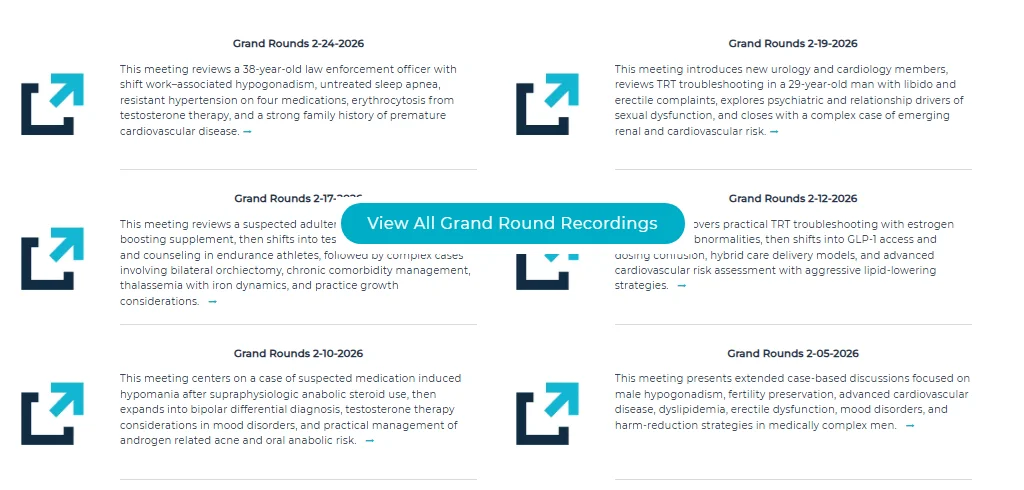
Testosteronology® Professional Education Program