

Laboratory Assessment And Clinical Interpretation
Module 2 trains clinicians to interpret hormone data with analytic discipline rather than numeric reflex. Across these courses, participants learn how assay methodology, binding dynamics, gonadotropin patterns, adjunct markers, and laboratory variability directly influence diagnostic classification and longitudinal monitoring decisions. The emphasis is on distinguishing physiologic signal from analytic noise, resolving borderline or discordant panels systematically, and preventing therapy changes driven by measurement artifacts. Clinicians develop repeatable verification pathways, method-aware documentation habits, and structured retesting strategies that improve continuity across laboratories and over time. By the end of this module, clinicians will approach hormone interpretation as a controlled analytic process grounded in physiology, method awareness, and defensible clinical reasoning rather than isolated thresholds.
Seven Training Courses
2-1 Principles of Hormone Assays and Analytical Methodologies
Learn how hormone assays are developed, standardized, and validated, and how analytic limits influence testosterone accuracy and defensible clinical judgement.
2-1 Principles of Hormone Assays and Analytical Methodologies
Learn how hormone assays are developed, standardized, and validated, and how analytic limits influence testosterone accuracy and defensible clinical judgement.
2-2 Total Versus Free Testosterone
Physiology and Clinical Application
Learn how total and free testosterone reflect binding physiology, when each measure is clinically useful, and how to apply results in complex endocrine cases.
2-2 Total Versus Free Testosterone
Physiology and Clinical Application
Learn how total and free testosterone reflect binding physiology, when each measure is clinically useful, and how to apply results in complex endocrine cases.
2-3 Estradiol Measurement, Assay Selection, and Clinical Interpretation
Learn how estradiol assay selection, sensitivity limits, and cross reactivity affect accuracy, and how to interpret results within androgen management.
2-3 Estradiol Measurement, Assay Selection, and Clinical Interpretation
Learn how estradiol assay selection, sensitivity limits, and cross reactivity affect accuracy, and how to interpret results within androgen management.
Testosteronology Society™ Advanced Clinical Training Program Courses Are ALL Included With A Testosteronology Society™ Membership
2-4 Luteinizing Hormone, Follicle-Stimulating Hormone, and Gonadotropin Patterns
Learn how LH and FSH patterns distinguish primary from secondary dysfunction and guide structured evaluation of complex androgen disorders.
2-4 Luteinizing Hormone, Follicle-Stimulating Hormone, and Gonadotropin Patterns
Learn how LH and FSH patterns distinguish primary from secondary dysfunction and guide structured evaluation of complex androgen disorders.
2-5 Prolactin, DHEA, and Adjunct Hormonal Markers in Androgen Evaluation
Learn how prolactin, DHEA, and adjunct markers expand androgen assessment, identify confounders, and sharpen diagnostic clarity.
2-5 Prolactin, DHEA, and Adjunct Hormonal Markers in Androgen Evaluation
Learn how prolactin, DHEA, and adjunct markers expand androgen assessment, identify confounders, and sharpen diagnostic clarity.
2-6 Common Laboratory Pitfalls, Assay Variability, and Diagnostic Errors
Learn how preanalytic variables, assay variability, and reporting differences distort hormone data, and how to prevent diagnostic errors.
2-6 Common Laboratory Pitfalls, Assay Variability, and Diagnostic Errors
Learn how preanalytic variables, assay variability, and reporting differences distort hormone data, and how to prevent diagnostic errors.
Testostronology Society™ Advanced Clinical Training Program Includes Access To All Grand Rounds Meeting Recordings
2-7 Interpreting Borderline, Discordant, and Complex Hormonal Profiles
Learn how to analyze borderline, discordant, and complex hormone patterns using structured reasoning that supports safe, accountable decisions.
2-7 Interpreting Borderline, Discordant, and Complex Hormonal Profiles
Learn how to analyze borderline, discordant, and complex hormone patterns using structured reasoning that supports safe, accountable decisions.
Learn How To Deliver the Highest Standard of Care in Testosterone & Ancillary Therapies for Men & Women
All 58 Advanced Clinical Training Program Courses Are All Included In All Membership Plans
Advanced Clinical Training Insights
Laboratory Assessment And Clinical Interpretation
Clinical articles that deepen your understanding of laboratory selection, timing, and trend analysis within testosterone and androgen care for men and women. Weekly publications sharpen interpretation discipline, strengthen diagnostic clarity, and reinforce defensible clinical reasoning across real-world patient scenarios.
EXCLUSIVE TRAINING BONUS
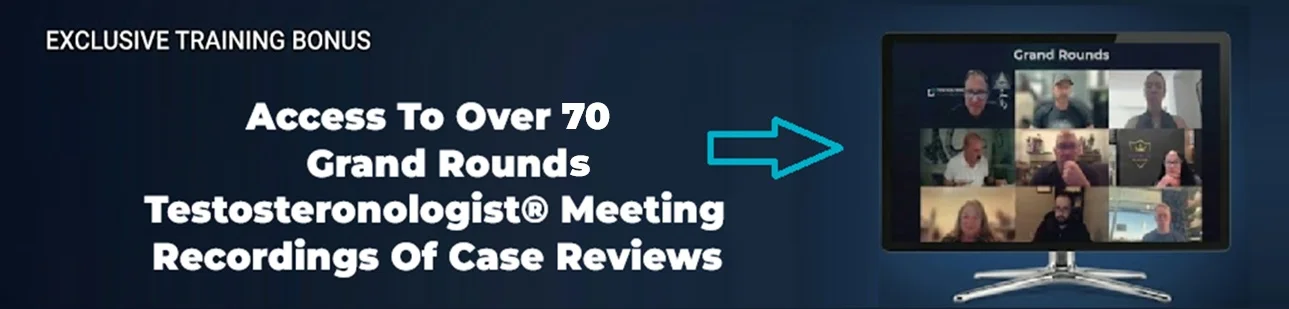
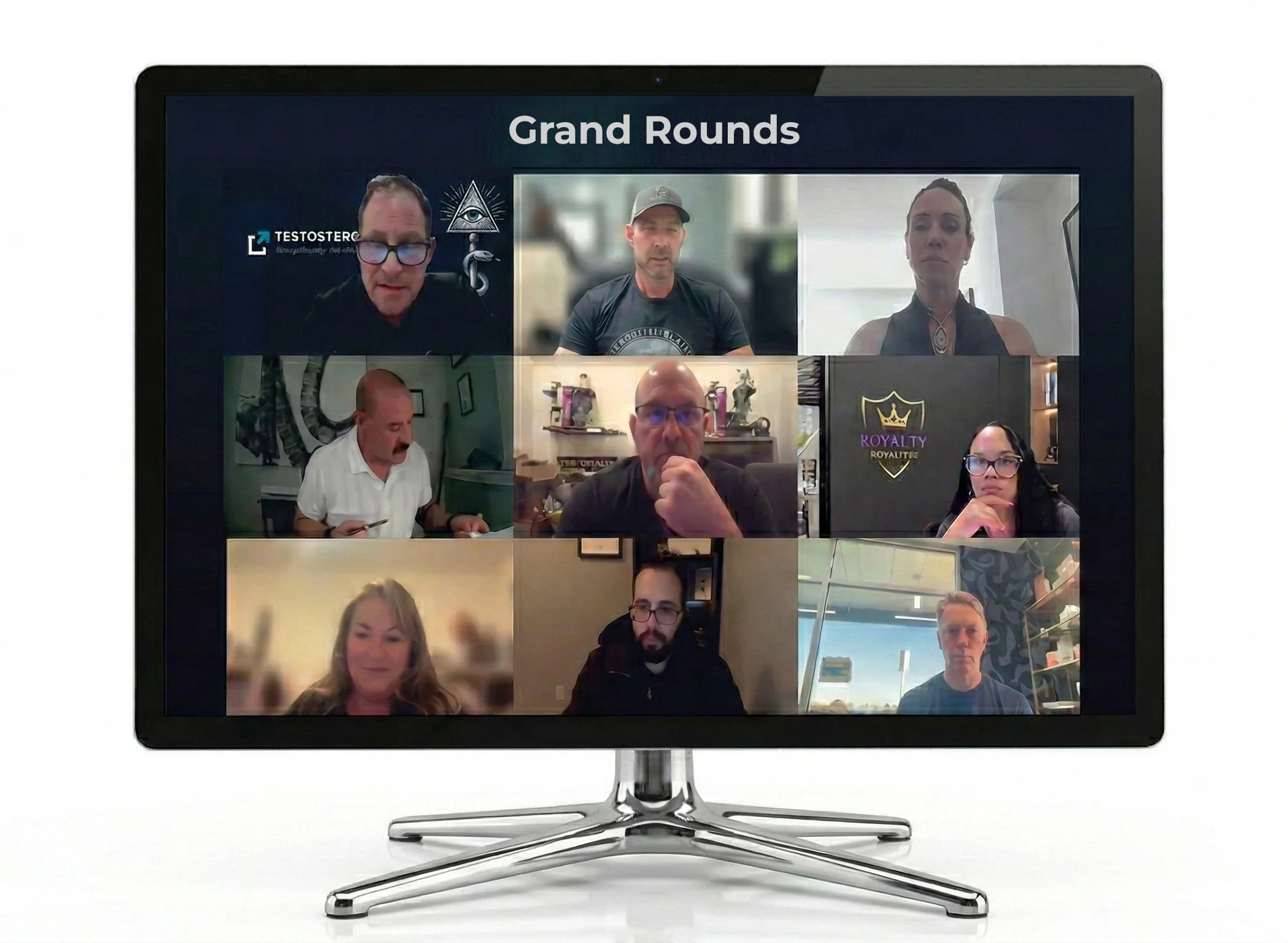
As a Testosteronology Society™ member, you receive unlimited access to more than 58 advanced clinical training courses plus member access to a growing archive of over 70 Grand Rounds meeting recordings.
Beyond structured coursework, you gain rare exposure to real-world, case-based discussions where Certified Testosteronologist® clinicians openly analyze complex presentations, decision-making under uncertainty, and defensible solutions in ways simply not available anywhere else in the world.
** As a Certified Testosteronologist, you also get to participate in these twice-weekly Grand Rounds video calls to bring your cases in front of the experts for guidance and action plans to help your patients.