
Androgen Deficiency Syndromes And Differential Diagnosis
Module 3 builds the diagnostic discipline required to classify androgen deficiency accurately before any therapy is considered. Clinicians will learn to distinguish primary, secondary, mixed, functional, age-related, and medication-induced patterns using structured laboratory interpretation, repeat testing rules, and driver-focused reasoning. The module emphasizes that symptoms alone are insufficient and that many common conditions mimic hypogonadism, requiring broader differential thinking and staged reassessment. Through pattern recognition and ABCDS™ integration, participants refine their ability to align biochemical findings with clinical context while avoiding both overdiagnosis and underdiagnosis. By the end of this module, clinicians will approach androgen deficiency as a classification problem requiring precision, reproducibility, and defensible documentation rather than reflexive replacement decisions.
Six Training Courses
3-1 Male Hypogonadism: Definitions, Classifications, and Diagnostic Criteria
Learn how male hypogonadism is defined, classified by cause and axis level, and diagnosed with consistent symptoms and biochemical testosterone evidence.
3-1 Male Hypogonadism: Definitions, Classifications, and Diagnostic Criteria
Learn how male hypogonadism is defined, classified by cause and axis level, and diagnosed with consistent symptoms and biochemical testosterone evidence.
3-2 Functional Versus Organic
Hypogonadism: Clinical Distinctions
Learn how to distinguish organic hypogonadism from functional forms based on underlying pathology, reversibility, and clinical and biochemical presentation.
3-2 Functional Versus Organic
Hypogonadism: Clinical Distinctions
Learn how to distinguish organic hypogonadism from functional forms based on underlying pathology, reversibility, and clinical and biochemical presentation.
3-3 Age-Related Androgen Decline
and Its Clinical Implications
Learn how gradual age-related declines in testosterone and androgen function influence symptoms, health, and the clinical approach to older men with low levels.
3-3 Age-Related Androgen Decline
and Its Clinical Implications
Learn how gradual age-related declines in testosterone and androgen function influence symptoms, health, and the clinical approach to older men with low levels.
Testosteronology Society™ Advanced Clinical Training Program Courses Are ALL Included With A Testosteronology Society™ Membership
3-4 Secondary and Mixed Hypogonadism: Etiologies and Management Strategies
Learn common causes of secondary and mixed hypogonadism, how hypothalamic-pituitary-testicular dysfunction manifests, and management strategies.
3-4 Secondary and Mixed Hypogonadism: Etiologies and Management Strategies
Learn common causes of secondary and mixed hypogonadism, how hypothalamic-pituitary-testicular dysfunction manifests, and management strategies.
3-5 Symptom Overlap: Conditions
That Mimic Hypogonadism
Learn how to recognize conditions whose symptoms resemble hypogonadism and how to differentiate them from true androgen deficiency in clinical evaluation.
3-5 Symptom Overlap: Conditions
That Mimic Hypogonadism
Learn how to recognize conditions whose symptoms resemble hypogonadism and how to differentiate them from true androgen deficiency in clinical evaluation.
3-6 Medication-Induced Hypogonadism: Mechanisms and Management
Learn how various medications suppress the hypothalamic-pituitary-testicular axis, cause hypogonadism, and how to adjust treatment to prevent or mitigate deficits.
3-6 Medication-Induced Hypogonadism: Mechanisms and Management
Learn how various medications suppress the hypothalamic-pituitary-testicular axis, cause hypogonadism, and how to adjust treatment to prevent or mitigate deficits.
Testostronology Society™ Advanced Clinical Training Program Includes Access To All Grand Rounds Meeting Recordings
Advanced Clinical Training Insights
Androgen Deficiency Syndromes And Differential Diagnosis
Clinical articles that expand on diagnostic classification, symptom pattern recognition, and differential reasoning in suspected androgen deficiency for men and women. Weekly additions refine how clinicians distinguish physiologic deficiency from mimicking conditions and overlapping drivers.
Learn How To Deliver the Highest Standard of Care in Testosterone & Ancillary Therapies for Men & Women
All 58 Testosteronology Society™ Advanced Clinical Training Program Courses Are All Included In All Membership Plans
EXCLUSIVE TRAINING BONUS
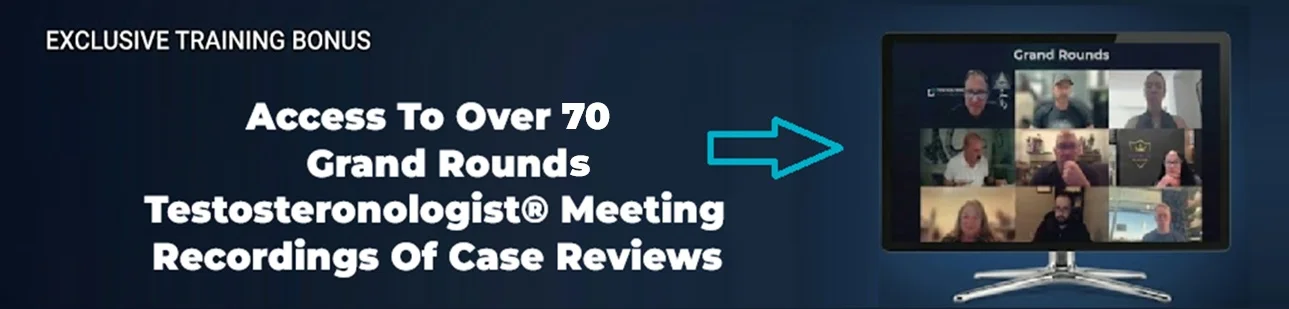
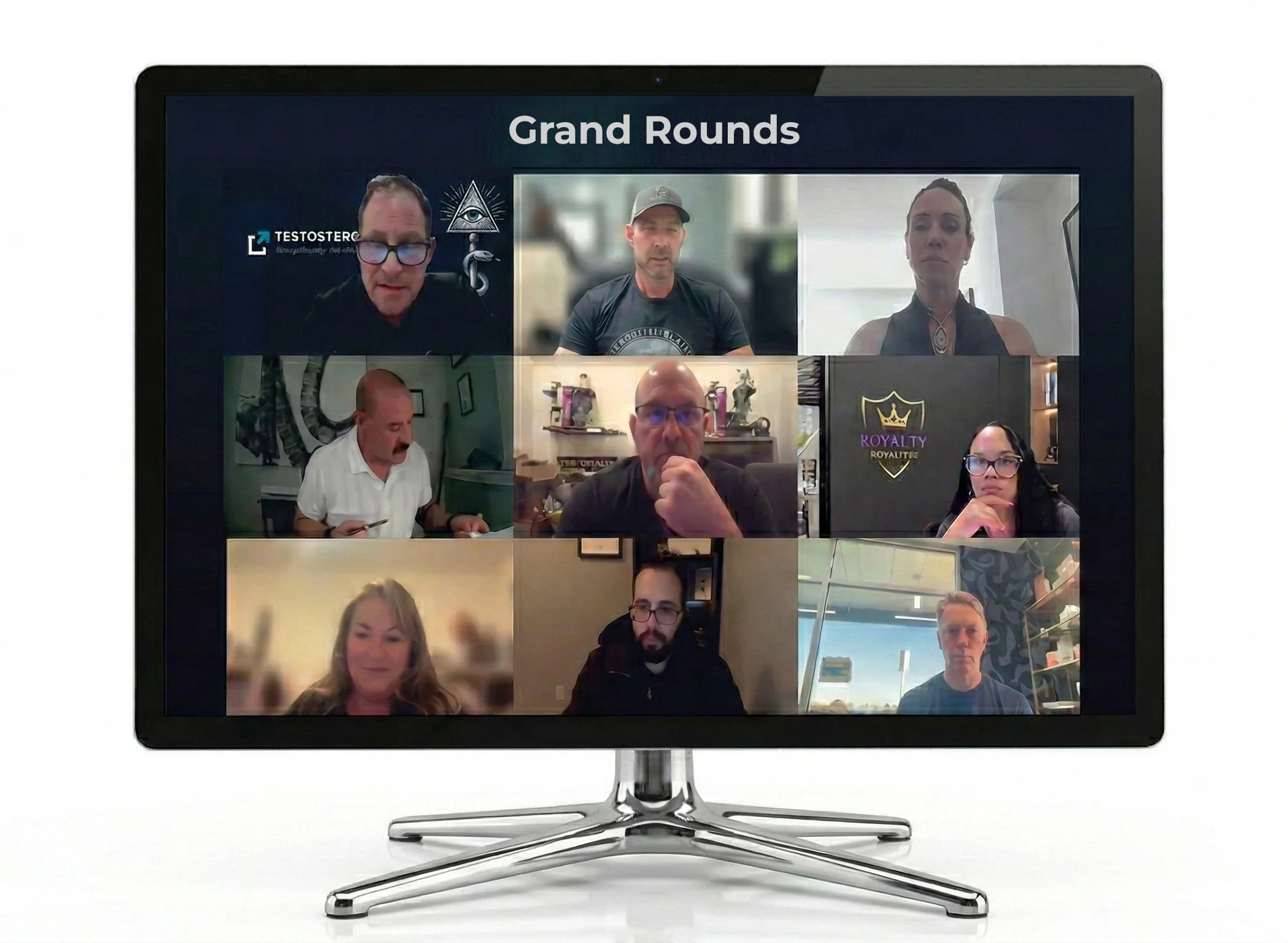
As a Testosteronology Society™ member, you receive unlimited access to more than 58 advanced clinical training courses plus member access to a growing archive of over 70 Grand Rounds meeting recordings.
Beyond structured coursework, you gain rare exposure to real-world, case-based discussions where Certified Testosteronologist® clinicians openly analyze complex presentations, decision-making under uncertainty, and defensible solutions in ways simply not available anywhere else in the world.
** As a Certified Testosteronologist, you get to participate in these twice-weekly Grand Rounds video calls to bring your cases in front of the experts for guidance and action plans to help your patients.